Sucreries : y se va la segunda!
Musique baroque et traditionnelle de la ville de Sucre
AVAILABLE ON TOUR 2026-28
2 FORMATS
-
Full-scale production: 70 mins 15 performers on stage (9 singers and 5 instrumentalists, plus 1 conductor) 16 people on tour
-
Abridged production: 60 mins 7 performers on stage (4 singers and 3 instrumentalists) 8 people on tour.
Both formats are presented without an interval and can be adapted to suit different programming contexts.
.jpg)
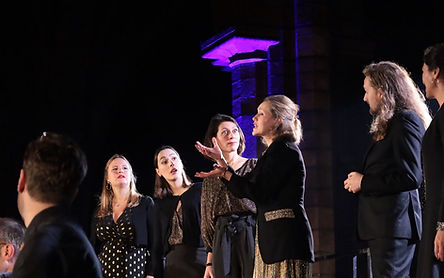
Carried by the voices of a choir and the sounds of period instruments, *Sucreries* transports us to the heart of Sucre, the ancient city formerly known as La Plata, high in the Andes. Drawing on scores preserved in Bolivia’s musical archives, Alkymia crafts a musical journey where the centuries echo one another and where a single energy is transformed over time and through cultural fusion.
At the heart of the concert resonate the villancicos, polyphonic sacred Baroque chants from Spain, where religious fervour blends with a festive energy carried by the voices and large ensembles. Composed for religious celebrations during the colonial era, these works have left a profound mark on the region’s musical life.
Over the centuries, these sounds have found a new resonance in 20th-century Bolivian folk traditions, notably the cuecas – songs and dances emblematic of modern-day Bolivia. ‘Y se va la segunda!’ (‘Here we go again!’), their closing announcement, prolongs the festive spirit and serves as a reminder of how the Baroque legacy continues to resonate in today’s popular repertoires.
Under the direction of the Franco-Bolivian conductor Mariana Delgadillo Espinoza, a research associate at the Bolivian Musical Archives and Libraries, the Alkymia ensemble creates a musical portrait of a city through its repertoires. *Sucreries* invites you to discover how an ancient heritage continues to circulate, reinvent itself and, for the duration of a concert, foster a dialogue between the celebrations of yesterday and the traditions of today.
REPERTOIRE
Villancicos from the National Archives of Bolivia, instrumental dances and cuecas by:
Juan de Araujo (1646-1712)
Simeon Roncal (1870-1953)
Sebastian Duron (1691-1716)
Matilde Casazola (1942-)
Santiago de Murcia (1673-1739)

Coproductions et soutiens : Archive et Biblioteca Nacionales de Bolivia, Spediam, Adami, CNM, CCR d’Ambronay, Musée des Beaux-Arts de Lyon.